High-Resolution Multi-Label Image Classification with ConvNeXt
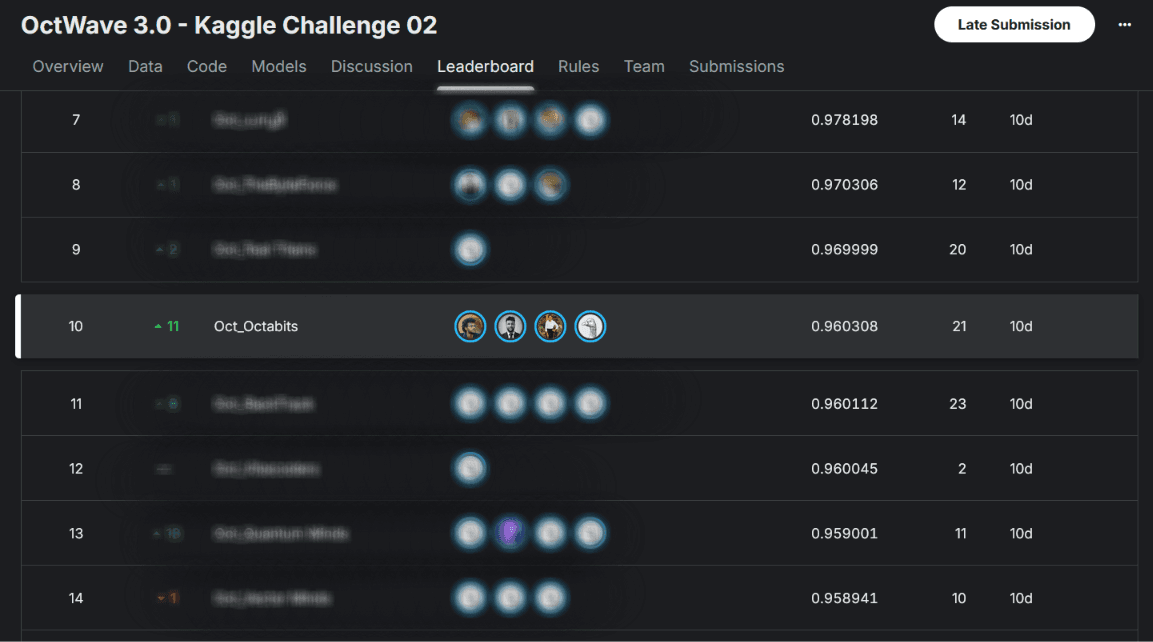
Finished 10th on the OCT Wave 3.0 Challenge 02 private leaderboard with a Macro F1 of 0.960308.
Turned a noisy four-class image-classification task into a high-resolution multilabel ConvNeXt pipeline through label auditing and error-driven experimentation.
Project Overview
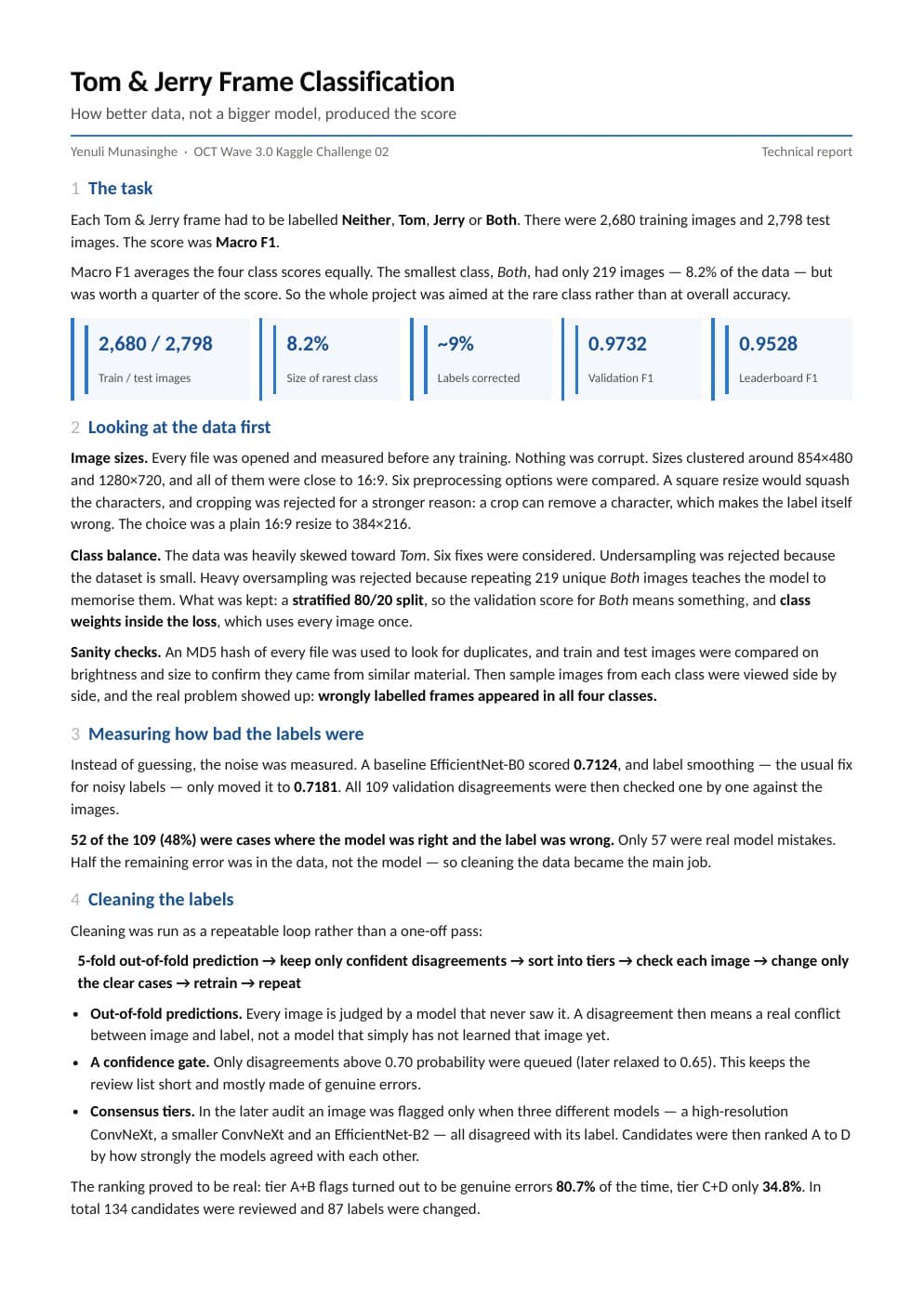
Built a high-resolution Tom and Jerry frame classifier for the OCT Wave 3.0 Kaggle Challenge 02. The task began as four-class classification - Neither, Tom only, Jerry only, or Both - scored with Macro F1, then evolved through label-quality auditing, multilabel reformulation, model diversity, threshold tuning, and analysis of model failures.
Project Description
An EfficientNet-B0 baseline revealed that model architecture was not the only constraint: suspicious samples exposed noisy training labels. Manual inspection and a model-consensus label audit enabled targeted corrections, while a multilabel formulation let the model learn Tom and Jerry independently. Every iteration followed a data, experiment, measurement, error analysis, and improvement loop.
- Started from an EfficientNet-B0 baseline, manually audited suspicious samples, and corrected noisy labels through a model-consensus workflow.
- Reformulated the four-class target as multilabel prediction, then evaluated ConvNeXt-Tiny, EfficientNet-B2, and Swin for performance and model diversity.
- Used 5-fold cross-validation, 512x288 and 854x480 resolutions, tuned class thresholds, and analyzed confusion matrices, confidence, and disagreement cases.
- Best local ConvNeXt model achieved Macro F1 0.973240 with 8 mistakes across 536 validation images; finished 10th privately with 0.960308.
- Built a selective hybrid prediction strategy after finding that unanimous, high-confidence models could still share the same biases.
Technologies Used
Competition Result
Report Slideshow